Archive
A Remembrance of Trees
My reach today is extending out to all the trees I’ve known in my life. I have a lot of Wood Element in my Chinese Astrology chart. Trees have always been important to me; and now as I practice the 5-Element Qigong form which ends on the “standing on stake” pose I imagine myself hugging one of the trees in my life.
As a child growing up on the family dairy farm in Wisconsin, I was surrounded by trees and their gifts. There were several stately Hickories out in the pasture; we gathered their nuts every fall and let them dry and age a bit. During the long winter nights we would crack their hard shells and patiently pick out the little meats. These would go into the most delicious “refrigerator cookies” you can imagine. The Horse Chestnut in the front yard didn’t give us edible fruit; its nuts were fun to play with but very bitter. The shade of that lovely tree was the best; the broad leaves were dense, dark green and not like other leaves. The farm was named for the Maples that divide the big lawn into two columns. These had been planted by the original owner of the farm and were nearing 100 years old when I was a boy. I had hoped they were Sugar Maples and tried to tap them for their sweet sap but with no luck there. The wild parts of the farm were filled with Oak; and, yes, we had many squirrels housed and fed by these stately beings. And a favorite was a clump of White Birch down in a ravine. I tried once to harvest some bark to use as “paper.” I hope I didn’t damage them then. They are gone now along with the Chestnut and Hickories.
I encountered some amazing trees in Africa. I was there for a few extraordinary years in the late 60s and was fortunate to live in Ethiopia and tour East Africa. I loved the Acacias, initially so foreign looking to this sheltered farm boy. There is an ancient and tenacious quality about these trees; they weather all sorts of climate change looking like they belong to another age. They have lived through much and have many stories to tell. I lived in the middle of the Rift Depression but still at about 5000 feet elevation. The highlands above my valley rose to 10,000 feet and as I climbed the trails to higher villages I walked through forests of Bamboo and Eucalyptus. The scents and sense of presence among these beautiful beings was amazing: the essence of the eucalyptus in that density brought on euphoria; I loved that walk!
I lived next door to a Magnolia for a while. She was a real lovely and showed off with incredible blossoms every late spring. At that time I had a huge old Pecan tree in the back yard. I tried to harvest her fruit but she was so big I couldn’t protect her babies from insects; I guess they had to eat too! And in the side yard this little weed-like tree appeared; the next year it bore fruit: delicious little figs! In another yard in another time I lived with a wild plum in the side yard. This was the first tree to bloom each spring; and her flowers were so dense they would blow like snow in the cool breezes to cover our cars; it was fun to drive away with these flakes of purity trailing behind.
At my beloved school in New Mexico there is a gigantic Cottonwood down by the creek. I was never there for her blowing cotton but there were shreds still clinging in the woodpile, even in the summer. Did you know these trees’ cotton dissolves in the rain taking nitrogen into the soil as it goes? Did you also know that the cotton has been bred out of these trees so they can be planted in Colorado Springs without the “nuisance” of that cotton? I planted one of those cottonless Cottonwoods to be a shade tree for our grandson who is very fair-skinned. Faithfully she grew incredibly fast; almost as fast as the grandson! Aspen come to mind here because I love them and tried to plant clumps with the cottonwood. I had no luck with them; they prefer altitudes higher than our 6700 feet in Colorado Springs. We had to drive higher to admire their beauty. Did you know Aspen are rhizomes. There is a colony in Utah thought to be a million years old!
I am so grateful for all these trees in my life; and there are many more! Every 5-Element Qigong form I practice I hug a different tree for the wood element; I have a lot of practicing to do!
Have you considered all the trees in your life; and the pleasure they have given you; and the life?

PS: It’s not too late if you want to meet a Medium and receive a message from The Other Side, Angels, guides, Spirits. Rosemary hosts a Conversation with The Other Side tonight, December 7 at 7:00 pm Eastern. This Conversation is held online; you can join from anywhere. Go here for details.


Love and Self-Love: Part 2
(Post-Epilogue: Today, November 30, I broke one of my special, probably most precious, Yixing teapots, one that I’ve had with me for years. Another loss, this one more permanent than misplaced reading glasses and a lot closer to my heart. Lesson? Another one; very hard this time? Really? Clearly I am in a fast-paced learning mode at this stage of my journey!)
Self-Love. Not a simple path. Practice Love; begin with self!
It is even difficult to go back to my last post and read my own words on this subject. How do I love self, the clumsy oaf who swept his pot from the counter in an over-exuberant flourish? But life hasn’t stopped and I must Love on!
My first step in working through the lesson today, the loss of another precious object, is to accept impermanence. It’s all just temporary, right? Let go. Yes, of course, grieve the loss. But within the grief is the built-in praise. I can certainly find gratitude for all the years of service the pot gave me. My memories of pouring tea from it, admiring the design, experiencing the beautiful color develop over the years of use are still with me to celebrate. This is another reminder of the cycle in everything; the pot began as dirt in a ditch in China; the dirt was harvested, hopefully with ceremony, thanksgiving and praise; then it was processed into clay, worked, hand-shaped, finished and fired; somehow it made it all the way from China to me safely; and now it returns to dust.
When I worked with micaceous clay in New Mexico with master potter, Felipe Ortega, we experienced the entire life-cycle of the clay. I made several small pots; and while my first attempts were nothing to take pictures of, they were special to me. One of the assignments, we later learned, was to sacrifice a pot to the Holy. We each broke one of our pots against a post as an offering, as a way of giving thanks for the clay and for our hands that shaped the clay, and the Holy who shaped us all. The shards remained in that spot for years afterward. And we each took a shard from that pile of rubble to grind down and incorporated into our next pot; the cycle was unbroken.
I can do this with a shard from my teapot. I can keep it going, giving, by recycling it in a personal and useful way. The object doesn’t go away, it only changes its shape. “Pots are fashioned from clay, but it’s the emptiness that makes a pot work.” – Taoteching, Ch. 11. The pot may be impermanent, but the clay is still there as is the emptiness!
As another step in the learning, can I turn the curse at my ill luck at breaking the pot into a blessing? This is another practice I learned in Bolad’s Kitchen with Martín Prechtel. Oh, yes, I did curse myself, my luck, my inattention, my carelessness, my mindlessness as I watched the pot tumble to the floor and become shards. Then I withdrew before my anger spilled over too far to hit others in the path of my negative energy, the antithesis of self-love. And I went inside for awhile. And as I write I am still processing, learning to do it through words coming from the inside rather than holding it all in where it churns and festers. Where are the blessings that come from this loss? In a sense I have already done some of this work, thanking the pot for its years of service. But what about me? Can I find a way to bless me through this lesson? This is where it gets really hard!
I am here, at the keyboard, writing words that will help me work through the curses that I can’t take back. I am letting go the anger, giving it to the compost heap where it can metabolize back into usefulness rather than metastasize within me. And I can recall the years with the pot and all the use it gave me and the care I gave it during those years; we took good care of each other for a good long time. And I can place the pot in a corner of my mind to remind me to come back, cycle back to the present moment. And I can know that the pot can help me pay attention to everything in the moment; to expand my awareness beyond a narrow focus and take in my environment, appreciating very thing around me and near and dear to me.
So, I bless myself for my deep thought, my appreciation for fine things, my attention to detail and my broad and extraordinary experiences that come together to inform and refine my approach to life, and the impermanence that threads through it All.
And with moist eyes I come back to Love, even self-love as I accept my blessings and learn a bit more about forgiveness.


A Review of “The Unlikely Peace at Cuchumaquic” by Martín Prechtel
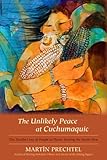
I recently finished reading Martín Prechtel’s latest book having preordered it and received it on its publication date. My long anticipation of the work and excitement to devour it in wholly massive gulps was only tempered by its importance and my savoring each bite as I moved through the elegant prose poem word by precious word treating each one as a seed for growth and understanding. This is a giant of a book unlike anything else out there. This work is itself an instruction manual for humanity to find an “unlikely peace” in this post-modern, post-everything chaotic world we are waking up to.
In the interest of full disclosure I first met Martín in 2002 at the Minnesota Men’s Conference. I had at that point read his first book, Secrets of the Talking Jaguar, published in 1998. I have since read everything he has written multiple times and will continue to read his books for the rest of my life. Each is built of many layers of information, knowledge and wisdom. And I am currently a participant in his school, Bolad’s Kitchen, in his third group known as the New Sprouts.
That said, The Unlikely Peace at Cuchumaquic is Martín’s most important work yet. It offers me many additional readings as I absorb each layer of the stories and the wisdom much like an archeologist peeling back the compost heap levels of ancient communities to reveal the underlying meaning and cultures that instruct us in ways to build a new community and a new culture in order to keep the seeds alive! These seeds are our seeds if we can find them. In fact these seeds are us. And they are vital to the very survival of humanity.
At first blush the part of the subtitle: The Parallel Lives of People as Plants, sounded a bit strange to me, and intriguing. Martín explains his meaning here very clearly, again in the extraordinarily multivalent way he has of bringing together complex thoughts and concepts into juxtaposition to deepen the understanding of his meaning. Read the book to discover for yourself how true this exploration of people as plants is!
As I read this book I found myself chuckling at the humor in the stories and anecdotes from his time in Guatemala. More often the tears would come as I went through both grief and inspiration as the words sank slowly into my psyche, almost at once plunging me into the depths of despair and rising to the heights of confidence and optimism as I with Martín consider the human condition and our future.
If you have had the privilege of meeting Martín you will hear him, see him and sense his very presence as you read his words. It is so good to have him close, just here on my shelf! And if you have not yet met him this is a wonderful opportunity to begin your journey toward an “unlikely peace” with yourself and your fellow humans! You will meet Martín on this journey.
The Unlikely Peace at Cuchumaquic ended much too soon for me. The work is totally satisfying and certainly complete meeting all the promises of the delicious title and the enticing Part and Chapter titles. I just wasn’t ready to let Martín go; I wanted to keep his voice in my head. So, I went back to his earlier book: The Toe Bone and the Tooth (now published as Stealing Benefacio’s Roses) to again savor that sumptuous feast and retain his voice echoing through my whole body down to the very core, that seed within!
If you have any sense that the indigenous cultures of humanity have something to teach us, if you are interested at all in how we can resuscitate a culture from the mess we are now in, if you have ever prayed for peace, if you love stories, if you are intrigued by the title, if you find yourself wondering where the human family is going, then read this book. It is important. It is powerful. It will make you cry – and laugh. And you will love yourself just a little bit more for having read it!

 Men and The Goddess