Archive
Men and Spirituality
Yes, it was a beautiful spring 70 degree day in Colorado. Yes, we are expecting somewhere up to 5 inches of snow between tonight and tomorrow night. And on the first day of Spring…yes, more snow likely. But that’s just fine with me because it is watering the yard – for free – thank you, Mother!
I just bought a book by Matthew Fox: The Hidden Spirituality of Men. I’ve enjoyed Fox’s work and have participated in workshops and circle dances for peace with him. He has done so much to steer the spiritual ship of humanity in a more reasoned and less hysterical/blind belief direction over the past 20+ years. It’s hard to believe his Original Blessing was published in 1983! I have not read his more recent works so I am looking forward to reconnecting with him, especially around the issue of men and spirituality. In the preface to this current work, he provides a couple dozen reasons he believes men’s spirituality remains hidden. I’m sure you can come up with a list that parallels Fox’s; the reasons range from insecurity to lack of training and vocabulary to the usual masculine cliches. And it’s a good list. But it strikes me that it is a list of passive traits; it’s a list of excuses we have made up and hide behind. And there is an active item that is not on Fox’s list: I think our culture, our society, what my teacher, Martín Prechtel, would call “the empire”, wants to repress spirituality in men, especially when we are at war, even a made up war – the so called “global war on terror.” (And we always seem to be at war, or preparing for war – hence the enormous defense budget we pay for every year.) Now, I’m not interested here in conspiracy theories or hypothesizing deliberate propaganda campaigns to keep men from expressing ourselves in spiritual terms. But I do think there is a decided and purposeful lack of encouragement for men to get deeply in touch with our spirituality.
In any case I am very much looking forward to reading this book. To a large extent Fox’s subject is why I am writing this blog. If he provides a way forward so men do begin to reveal their ‘hidden spirituality” I will recommend it highly!
Meanwhile, I believe there is much evidence out there that men are becoming more forthcoming about their spiritual lives. I am encouraged by two very recent examples from my own life:
I hope you all read my blog on Monday when I posted an essay on the Harbingers of Spring by Don Ellis. These are words from a man who is very much in touch with his spirituality. He writes “If I could choose to live again the Springtime of my life, I would again choose to live it where the meadow lark announces the season of reawakening.” Eloquent words spoken from the heart.
 And yesterday I was with a friend and shared with him a dream I have to circumambulate the sacred mountain in western Tibet, Mt. Kailash. This is a pilgrimage of many faiths, especially for Buddhists and Hindus. The mountain is considered the “navel of the earth” or the Axis Mundi. It has never been climbed; that is not allowed. It is walked around; the trek takes days and the high-point of the walk is crossing Drolma La Pass at 18,000 feet. I first read of this pilgrimage in Circling the Sacred Mountain by Robert Thurman and Tad Wise, a lovely book of spiritual teachings by Thurman and an entertaining travelogue by Wise. And as soon as I finished the book I wanted to set out! I am now, if I’m lucky, two years away from this dream. But I digress! After sharing my dream with my friend I later have dinner with him and his wife. In addition to the lovely dinner I am given a gift bag, complete with a beautiful picture of Mt. Kailash, Tibetan incense and prayer flags. He said he wanted to energize my dream! I don’t call that “hidden” spirituality.
I am encouraged. And I write to be even more encouraging. It is time for men to express their feelings, their joy and grief, their spiritual insights. How do you express your spirituality? And if you don’t, now is the time to start. Respond here with your thoughts, dreams, fears, and insights. It is a safe place! Blessings for your journey around “the sacred mountain.”
Spring is just around the corner; not that we are anxious!
Our “little or no accumulation” of snow yesterday amounted to three inches! It is melting quickly today and tomorrow will be in the 60s. I love this time of year with fickle weather, unexpected returns to winter and wonderful hints of Spring. Newness is in the air and everywhere I look.
Today we have a new moon bringing in a fresh look to the evening skies and the energy of the planet. It’s a great time to let go of old stuff, whatever that is. The old moon is taking its last breath and will sweep away any of the “clutter” that might be holding you back. And on Saturday as the Sun moves into Aries to begin the new astrological year, Spring rolls in with it. The Vernal Equinox on Saturday is the day of balance between light and dark. It is this balance that is required in everything. If we are to bring in new then old must be chucked.
Persephone is the Greek Goddess of Spring. She’s the Goddess captured by Haides and abducted to the Underworld to be his wife. She was rescued but still had to spend some of her time with Haides. She returned from her Underworld sojourn in Spring and brought with her fresh growth and new beginnings. She returned to Haides for the balance of her time in the fall as growth ended in withering and death. Persephone’s story reminds me of Inanna’s which is much older and the likely basis for the Greek stories.
So, we look for Persephone’s return! I saw my first Robin last week no doubt looking for sluggish, still nearly frozen worms. In telling this story at our Sunday Celebration yesterday I reminded Don of his story on his harbingers of spring. It is so good I am including it here for your enjoyment:
Harbingers of Spring
The return of the robin, businesslike in his red vest industriously extracting earthworms from the front lawn, is a sign of Spring so enshrined in American art and literature that it is almost a cliché. So, too, is the first crocus, small and delicate in the garden testing the cold air and the lingering snow as it reaches up, opening itself to the sunshine of the lengthening days. Despite the overused words and oft reproduced images recapitulating these annual events, the events themselves are new and fresh each year. For many, they herald not only the biological reawakening of a new growing season but also a personal emotional revitalization.
For much of the time when I was growing up in the 1940’s and 50’s, the only water we had fell from the sky or was hauled from a spring in jugs and cans. And, even after we got water from a pipeline, our attempts to grow a garden or a lawn met with limited success. So, the harbingers of Spring which touched my youthful soul (and still touch me the most deeply) were different, wilder, more robust.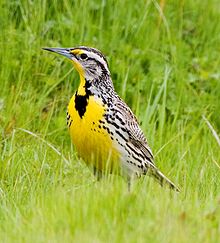
Spring was heralded, not by the robin, but by the meadow lark standing erect on a fence post, yellow bib bared to the world, loudly trilling a crisp melodious flute like greeting to all, as I passed on my walk to school. Rather than the smooth petite crocus of the garden, I saw the floral face of Spring in the larger, hairy, almost disheveled, yet delicately beautiful pasque flower.
If I could choose to live again the Springtime of my life, I would again choose to live it where the meadow lark announces the season of reawakening.
 Perhaps that is one reason I am passionate preserving those wild places where our increasingly urbanized and regulated community can reconnect with the meadow lark and the pasque flower, the dynamic order of nature in contrast to the designed and manicured order of the city.
Walk the Section 16 trail connect with the pasque flowers.
We are at the beginning of a new season!
Don Ellis
Thanks, Don!
What are your harbingers for this wonderful season of newness and growth?
Men and Grief (Part 3)
I put a big ding in my relatively new guitar this morning. I usually begin practice while steeping tea. This morning I forgot to set the timer for the tea and got up from my chair, guitar in hand, to set it; not my typical routine. As I turned to go back to practice I banged the guitar’s face into the corner of the the tea cart.
My first reaction was anguish followed immediately by anger, flashing white-hot: anger at the universe for setting this event in motion followed immediately with anger at myself for being clumsy, mindless, out of rhythm…Words were used to express this anger, not peaceful words, not high vibration words I would choose to share with anyone; words spilling mindlessly from an ill-tempered mouth.
I retreated to my “cave” to spare others from my venting, to salve my hurt, to recover some balance. “What is this?” comes easily to mind, long minutes too late, but the question remains hanging over me. My guitar practice, making tea, sharing a moment with Rosemary are all mindfulness practices for me during beautiful new days. Yet, how quickly I plunged into mindless anger. I went on with my other routines.
I asked during yoga practice: “What is this?” During stretches, asanas and concluding meditation the answer comes: mindfulness practice is exactly this! Whether we are sitting on our cushion, making tea, practicing guitar, lessons arise; thoughts interfere with following the breath, a forgotten timer interferes with the routine of the tea, a dinged guitar brings us up short in our practice and throws us into the ditch of samsara.
I move on to my “morning pages”, a practice recommended by Julia Cameron in “The Artist’s Way.” I’ve been doing this with reasonable regularity for years; it is very helpful in clearing away the cobwebs of the mind. I sit to write in our sanctuary and ask: “What is this?” And I write of my perfectionist ways, my Enneagram type 1 personality which at the superficial level demands perfection. My guitar is no longer perfect; it is dinged. Oh, it will sound no different in my amateur hands; I don’t play perfectly, so why must the guitar be perfect? The evolved Enneagram type 1 human realizes the world, the Universe is already perfect; it is just the way it needs to be; it just IS. “What is this?” This is a lesson in impermanence. We live in an entropic Universe; everything tends toward a more natural state of higher entropy: destruction, decay, death are all natural processes with which we live. Guitars get dinged.
I move on to write “a poem for the day”, and ask “What is this?” The wheel turns, more lessons await, always lessons. Practice more, sit longer, breathe into the cycle. Thoughts arise, come back to emptiness; dings happen, come back to emptiness; loss comes, feel the grief; grief arises, find your center, emptiness.
A dinged guitar is a small thing, a small loss. It offers a small lesson for the day. It brings me back to center after a trip or two around the wheel and after some focused practice to understand and accept the ding, my reaction, my work, my return to the breath, to the present moment, all I have, all I will ever have.
I’ve touched on a few practices I find useful in my life of lessons and constant cycling (I hope spiraling) toward “the heart of perfect wisdom.” There are many mindfulness practices, some I use on a daily basis as I’ve illustrated, some like shamanic journeying, chanting, drumming I use less frequently, and others like holotropic breath work, sweat-lodge, fasting I use infrequently for major “spiritual emergencies.” There are as many ways to approach inner work as there are human beings. The importance is to approach it!
Men and grief; many of us don’t do it well. If we have the knowledge and the tools, the wisdom of the grieving process and its importance will surely follow.
Men and Grief (Part 2)
Greetings from a sunny but cool day in Colorado. While the outdoors calls to me and Spring beckons from just a few days away I feel compelled to sit at my screen and write part 2 of what I began on Tuesday. And there is much to explore!
I hope everyone has a chance to connect with a comment I received on Tuesday’s post from Joseph Gelfer. He offers an extraordinarily thoughtful article from the “Journal of Men, Masculinities and Spirituality” for which he is the Executive Editor. The specific article is: “Men, Loss and Spiritual Emergency: Shakespeare, the Death of Hamnet and the Making of Hamlet” by Peter Bray.
In his article Mr. Bray explores grief in the context of Shakespeare’s losses (11 year-old son, Hamnet, and father) around the time he writes “Hamlet.” His other major framework for this exploration is the work of Stanislav and Christina Grof in the areas of pre- and perinatal psychology and transpersonal psychology. There are three elements of this article I would like to pursue today.
The first is a classification of grief itself and human response to grief into what Mr. Bray describes as a spectrum ranging from “instrumental grieving” to “intuitive grieving.” These poles correspond respectively to masculine and feminine approaches; men tend to “prefer ‘problem-focused’ strategies to manage their grief” while women are “generally more accustomed to attending to their emotions and more able to carry out the tasks defined in grief work,” an approach “shown to be marginally more effective.” Essentially men tend toward what I’ve referred to as “stuffing” their grief, getting back to work, on-task, buried in the daily activities of “normal” life; women tend to go into their grief, work with it, perhaps in a grief workshop or bereavement group. The most interesting point of Mr. Bray’s classification approach is that there doesn’t seem to be a lot of evidence to indicate which strategy is more effective; in fact, “neither gender’s assigned coping strategy in adjustment to grief has yet been conclusively proved superior to the other.” For me this is surprising. But the evidence is thin because men don’t talk much about their grief. This leads me to my second point.
Mr. Bray concludes his well researched and deeply thoughtful article with a call for more research and better tools and means to offer men who find themselves in what Grof labels “Spiritual Emergency,” often triggered by loss. He writes: “there is little awareness in our communities of what consciousness transforming crises as a result of loss might be like for men and it is suggested that such deeply personal events go largely unreported or unrecognized.” Yes, this is my whole point in these posts on “Men and Grief” – we don’t do it well, we don’t have the tools or skills, we are not guided, we don’t talk about it and we don’t even have a base of literature and research to draw from when (or if) we seek help! As men we don’t know how to grieve effectively. So, do we go to war instead?
The third element I would like to point to from Mr. Bray’s observations is the work of Stanislav Grof which forms the structure for much of the article. It is Grof’s explorations and his technologies for inner work which may hold at least one of the keys to reaching a better understanding of loss and grief and finding better ways to cope with these spiritual emergencies. This approach has helped me in my personal life in dealing with loss. Inner work takes many forms and I have explored many, including Grof’s holotropic breath work. It is this inner work, which can range from passive moving toward emptiness meditation to active breath work, writing, chanting, dancing, drumming, sweat-lodge experiences, that can lead to deeper healing and deeper understanding of human reality: “consciousness reality” which extends far beyond the “consensus reality” of our “normal” lives.
There are many ways and tools to help us cope with grief. I will explore those I’ve experienced in tomorrow’s post with the hope that one or more may help you deal with your loss. And we all have loss to deal with.
Men and Grief (Part 1)
Yesterday I wrote about men learning how to nurture and explored the role of women in teaching men. And I argued that perhaps it is not up to women to teach us but rather for us to go inside and find our hearts, find our compassion, find our nurturing spirit there. This is, of course, easy to say. But for many of us it is not so easy to do. And, perhaps there are some stages we need to address, some growth areas to go through before we get all the way to our nurturing spirits.
Men have heart; it is inside them; and they can get in touch with it, frequently do! Too often that heart, that feeling comes bubbling, even bursting out as anger. I’ve encountered angry men much of my life. In fact, again too often, I have been an angry man. Where does this anger come from? Why are men angry and what are they angry about? I believe a lot of our anger comes from stuffing our feelings, way down deep in our dark places. These feelings are unprocessed, unexamined; they are hidden and raw. They come up and out, flashing and hot, as anger; often we may not even have a particularly good cause behind the anger. It doesn’t take much to trigger repressed feelings. And, anger is the one emotion that it seems safe or comfortable for men to express: “men are men” and can be “rightfully angry.”
But how “grown up” is it to only express our feelings as anger? Is there a more conscious way to behave, a more evolved, higher-vibrational way to express our passion?
A first step is to process feelings rather than stuff them. And I believe one of the primal feelings that men stuff is their grief. There has been a lot of excellent work done around this subject. Grief is one of the key motivating forces behind the so called “men’s movement” from the early 1980s spear-headed by wonderful men like Robert Bly, Robert Moore, Michael Meade and the other leaders of the mytho-poetic men’s movement. Robert Bly, extraordinary poet and severe critic of the Viet Nam war, all war actually, examined men’s grief in the context of returning Viet Nam veterans. There is a lot of grief about that war on all sides. It usually was expressed as anger, but the underbelly of that anger was grief. There was a shared grief about that whole era from the late 60s on; and a lot of it remains unprocessed, unexamined. And, it’s pretty clear that few lessons were learned by those of us who lived through that time. But in the 80s some of us began to process some of that grief. It is a long process.
Another of my excellent teachers I am so blessed to have in my life, Martín Prechtel, also does a lot of work around grief. He offers a recording that I highly recommend to everyone; it is a deep expression of something I am trying to get at here; “Grief and Praise” is available: www.floweringmountain.com/CATALOG.html.
We have much to grieve! Some things are immediate and personal, like the loss of a loved one, a parent, a friend; some may be a bit more distant but no less personal, like the loss of life through natural disasters we seem to be experiencing at an accelerating rate; some may be distant in either space or time, like wars in Afghanistan and Iraq, or war in Viet Nam, assassinations; and some may be very distant like our national history of slavery and genocide. Once we start digging there is much to grieve!
In the current issue of “Archaeology” there is an article on “Cloning Neanderthals.” Recent evidence indicates that Neanderthals and Homo sapiens were in in contact for several thousand years and there was likely some interbreeding. Neanderthals “disappeared” – became extinct – about 30,000 years ago. Did Homo sapiens have anything to do with that extinction process? We will never know, but I wonder if old stories, like Cain and Abel, are some ancient, “cellular memory” of that evolutionary process. And is part of our interest in bringing Neanderthal DNA back to life in some way motivated by our unexamined grief?
Perhaps I reach back too far. And perhaps there is no reason to reach back very far at all. Grief, like so many things to be examined, is like an onion: as one layer is peeled back another is revealed. And the deeper we examine our feelings, especially grief, the deeper we can experience true and healthy emotions.
There is a lot here; I am far from peeling away the layers to get to compassion. I’ll continue this thread on grief in Thursday’s post.
Meanwhile, how are you in touch with your grief?
Men Learning to Nurture
It was a fine weekend. We got Rosemary off to LA safely where she is busy with a business coaching intensive. Meanwhile I stayed home to take care of business! I got to play with numbers from 2009, getting ready for tax time! What a joy…I finally gave up on QuickBooks after getting myself into trouble and turned it all over to our book-keeper this afternoon! Phew, that’s a load off!
We had a very nice Sundays at The Center Celebration yesterday with a great turn-out. It must have been the spring-like weather here in Colorado Springs; people seemed to be out everywhere! While Rosemary is away our friend and colleague, Finbarr Ross, offered the message and meditation at our Celebration. And his words were thoughtful and meaningful! One of his concepts especially stayed with me and I’m still giving it thought.
He began with “we are in the time of the woman.” I definitely subscribe to that; this is exactly what is motivating this blog! We are moving through a time of feminine energy ascendancy to begin to right the balance we are so desperate for now. He concluded that women need to show men the nurturing way. And this is the thought I continue to work with today.
I agree that men need to move toward a more nurturing approach to life. What I’m struggling with is placing the burden of showing men how to nurture on women. Is it their job to teach us this kinder, gentler way of life? As children we were all nurtured in some form by our parents, guardians, some of whom were likely women; many of the fortunate among us were nurtured by loving mothers. And as boys we had friendships with girls in school, teachers, aunts and girl cousins. Did we not learn anything from these associations, many of them loving?
Yet, we were not taught to be nurturing; there was no curriculum, no catechism of stories and myths of men nurturing and caring for others. Quite the opposite. So, while we may have seen many wonderful examples of nurturing, we were not encouraged to emulate those models.
But what can women do now to change this? If men are not taught and men have no motivation to become nurturing creatures, is there something to be done? At the close of yesterday’s Celebration we listened to a lovely piece of music by Catherine Wilson on her album, Seeds of Light; the song: The Answer Lies Within. I believe the answer to how men may become more nurturing lies within the hearts of men themselves. Yes, women can show the way, they can encourage us toward a gentler path, they can demonstrate compassion, they can lead by modeling. Men need to look inside, we need to search for better answers, and as the song goes: “The answer lies within, my friend.”
I have been fortunate through much of my adult life to look within. It was years ago I learned that in my astrology chart my North Node of the Moon is in the sign of Cancer. I don’t want to get technical here, but the North Node points to growth and potential; it points to your lessons. Now it happens that Rosemary is a double Cancer; both her ascendant and moon are in Cancer. Do you think it is coincidental that we have been together for nearly 30 years? And I sure hope I’m learning some of those lessons! Cancer is the sign of caring, of homemaking, of, yes, nurturing! Is it Rosemary’s job to teach me how to be a Cancer? No, it’s my job to learn how.
I have another pointer to my case. Rosemary and I are students of the Enneagram, a model of personality types (I’ve seen it labeled as a psychospiritual typology). Again, I don’t want to get technical here, but I am a type 1, “the perfectionist” – I like everything to work or I will try to fix it so it does work. Rosemary is a type 2, “the helper” – she sees people in need and wants to “nurture” them! Once again my lessons are in my face!
But it’s up to me to see them, to learn them. My nurturing self is inside of me. And with all the modeling, teaching, way-showing in the world at my disposal it is still up to me to find that nurturer with myself.
That nurture is the Divine Feminine energy working within me. Can you find it within yourself?

 Men and The Goddess