Archive
Men and Emotional Health – Grief
In recent posts I’ve been writing about emotional health and balance. And just yesterday I included some thoughts about balancing yin and yang energies as we go inside to seek guidance, to switch on our internal GPS and determine if any course corrections are needed. In these turbulent times, the waning days of 2012, I’m finding the need to go inside frequently to establish balance and take a close look at my route forward!
And part of what is going on for me, what I’m working on is processing grief. Sometimes I look back on my life and sense that I’ve done a lot of grieving, and of working through the grief that so many men seem to feel. This goes back to the 80s and Robert Bly’s Mytho-Poetic Movement. He was all about the grief process and how little western society allows any real space for this emotion. Another of my teachers, I met him through Robert, addresses grief as one side of a coin; the other side is praise! This comes from Martín Prechtel (see my review of his most recent book).
What Martín offers is very much in keeping with the Taoist approach to transforming emotions to virtues which I addressed here a few days ago. For Taoists Grief is transformed to Inspiration.
Grief is a good way to end this series on the transformation of emotions. We in the west pay much too little attention to this deep emotion. It is our unexpressed, unprocessed, unmetabolized grief, even more than anger, which leads us into wars. Grief leaves us empty if we don’t deal with it. And we then fill that emptiness with aggression. A milder but still potent manifestation of this emotion is Disappointment. Here again we have no good way to process this. We need to learn to transform grief and disappointment to Awe, Inspiration and Praise. Again there is deep Inner Work needed to work through this emotion. Our stories help with understanding. Meditation helps with moving from Grief to Praise, from Disappointment to Inspiration.
Grief is often associated with death, of course. Death is the ultimate loss. When we lose something, especially a loved one, an emptiness opens up that is difficult to fill. When we go inside and touch that emptiness we too often shrink away from it. It is a cold and bitter sensation that we would rather avoid, cover up, fill in, and ignore. None of us likes that hollowness; it is painful!
So, how do we get to Inspiration and Praise from that lonely, empty place? How can we even suggest that there is Praise on the other side of Grief? When we lose someone truly close to us through death, we turn to celebrating a life lived well. We remember shared stories, inspiring moments together, important milestones on our shared journey. We find many ways to praise that life. And from the specific, from that loved one’s life, we can expand to celebrate Life, the larger cycle of Life and Death in the great context of Becoming.
Here we find connection. And through this connection to the Greater we can begin to fill in the empty hole in our middle. This is a lengthy process. It takes time and work, inner work, to reach for the connection; to move into the context of Life. This is where we find Inspiration and reason enough for Praise.
Grief to Praise. It is not an easy route; it takes time (more than the three days offered by businesses to employees for the death of loved ones!). It requires an expansion; the hole in the heart is not filled in but the heart expands to somehow accommodate the hole! Take the time for this expansion process. If you find yourself grieving, whether it’s for the loss of a loved one or some other great loss (job, home, youth, energy, health…) sit with it; touch it gently; move into the emptiness; begin to see the possibility for expansion. Do the inner work, a bit at a time as you can.
And remember to bless yourself in this great work!


A Review of “The Unlikely Peace at Cuchumaquic” by Martín Prechtel
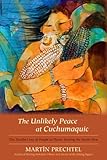
I recently finished reading Martín Prechtel’s latest book having preordered it and received it on its publication date. My long anticipation of the work and excitement to devour it in wholly massive gulps was only tempered by its importance and my savoring each bite as I moved through the elegant prose poem word by precious word treating each one as a seed for growth and understanding. This is a giant of a book unlike anything else out there. This work is itself an instruction manual for humanity to find an “unlikely peace” in this post-modern, post-everything chaotic world we are waking up to.
In the interest of full disclosure I first met Martín in 2002 at the Minnesota Men’s Conference. I had at that point read his first book, Secrets of the Talking Jaguar, published in 1998. I have since read everything he has written multiple times and will continue to read his books for the rest of my life. Each is built of many layers of information, knowledge and wisdom. And I am currently a participant in his school, Bolad’s Kitchen, in his third group known as the New Sprouts.
That said, The Unlikely Peace at Cuchumaquic is Martín’s most important work yet. It offers me many additional readings as I absorb each layer of the stories and the wisdom much like an archeologist peeling back the compost heap levels of ancient communities to reveal the underlying meaning and cultures that instruct us in ways to build a new community and a new culture in order to keep the seeds alive! These seeds are our seeds if we can find them. In fact these seeds are us. And they are vital to the very survival of humanity.
At first blush the part of the subtitle: The Parallel Lives of People as Plants, sounded a bit strange to me, and intriguing. Martín explains his meaning here very clearly, again in the extraordinarily multivalent way he has of bringing together complex thoughts and concepts into juxtaposition to deepen the understanding of his meaning. Read the book to discover for yourself how true this exploration of people as plants is!
As I read this book I found myself chuckling at the humor in the stories and anecdotes from his time in Guatemala. More often the tears would come as I went through both grief and inspiration as the words sank slowly into my psyche, almost at once plunging me into the depths of despair and rising to the heights of confidence and optimism as I with Martín consider the human condition and our future.
If you have had the privilege of meeting Martín you will hear him, see him and sense his very presence as you read his words. It is so good to have him close, just here on my shelf! And if you have not yet met him this is a wonderful opportunity to begin your journey toward an “unlikely peace” with yourself and your fellow humans! You will meet Martín on this journey.
The Unlikely Peace at Cuchumaquic ended much too soon for me. The work is totally satisfying and certainly complete meeting all the promises of the delicious title and the enticing Part and Chapter titles. I just wasn’t ready to let Martín go; I wanted to keep his voice in my head. So, I went back to his earlier book: The Toe Bone and the Tooth (now published as Stealing Benefacio’s Roses) to again savor that sumptuous feast and retain his voice echoing through my whole body down to the very core, that seed within!
If you have any sense that the indigenous cultures of humanity have something to teach us, if you are interested at all in how we can resuscitate a culture from the mess we are now in, if you have ever prayed for peace, if you love stories, if you are intrigued by the title, if you find yourself wondering where the human family is going, then read this book. It is important. It is powerful. It will make you cry – and laugh. And you will love yourself just a little bit more for having read it!

 Men and The Goddess