Archive
Goddess Guidance Oracle Cards: Pele and Winter Birch
It’s Tuesday in beautiful Colorado; the sun is high and bright, the temperature is predicted to approach 80, and the wind is blowing to keep things cool. I’ve set aside the day to get out in the garden and tend to the newly greening and growing life of “new Summer” now that we have celebrated Beltane!
But first I drew two cards for the day to get in touch with the Goddess energies influencing our times. I am so glad to be getting back to this regular practice and to share it in this way. As Rosemary mentioned in her comment on my first post of Goddess Card work last Friday, using divination cards is a wonderful way to get in touch with the intuitive, Higher Self. And while I am drawing these cards and interpreting their meaning within my own context, do know that my intention is to gain and offer guidance for all of us, not just for me.
That said, today’s Goddess Card from the Doreen Virtue deck is Pele, Divine Passion. Pele is the Hawaiian Goddess of volcanoes. Dr. Virtue says: “She shows us that fire can purify, release us from the old to make way for the new, and ignite our passions.” And Pele’s admonition is: “Be honest with yourself: What is your heart’s true desire?” This is wonderful advice for these times of change. We are out of time; we can no longer procrastinate and wander aimlessly through our lives. Find your purpose, find your passion (they are completely interrelated) and live them! This begins with being passionate about yourself. You are important; you have a unique purpose in this lifetime. Call on Pele to burn up the old, wandering self and ignite your inner fires; get in touch with your Higher Self and love that person entrusted with this purpose.
Today’s Grandmother Card is Winter Birch of Woman’s Lodge. She offers her strength to support us in our purpose and passion: “No matter how great the burden or how difficult the task, my flexibility enables me to shoulder the load and bounce back. This has been of value for some of the others who had difficulty letting go of rules and judgments.” Yes, strength to let go of other people’s rules and judgments! With the coming changes the old rules don’t apply; other peoples judgments do not pertain; remain flexible and strong knowing the burdens given to us are never too much, can not break us as we move into our purpose and passion.
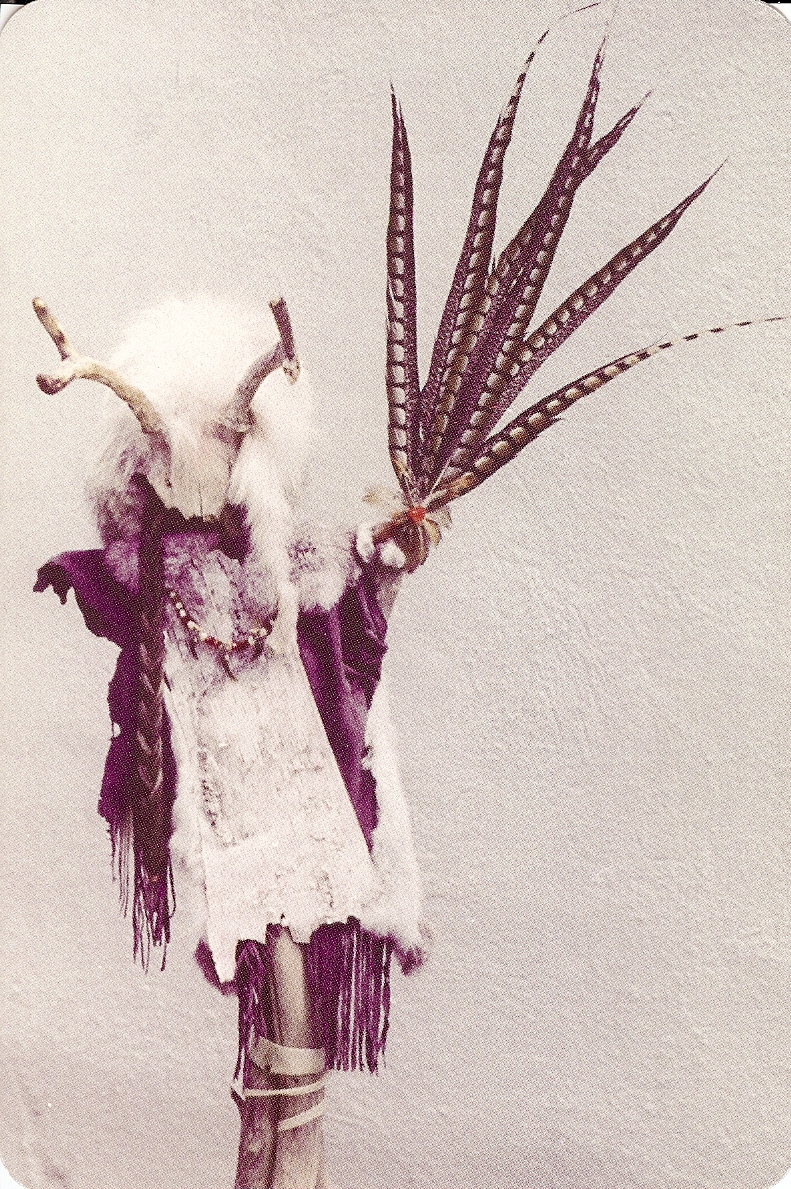 Note on the Grandmother Cards: the actual title is Grandmothers by Megan Garcia, published by Books Beyond Borders, copyright 1995; the ISBN: 1-883862-06-X. I offer all this information because the deck is out of print but is available if you search for it; I got mine in new condition from Powell Books several years ago. I’ve included here a scan of the image of Winter Birch of Woman’s Lodge so you get a sense of their style and beauty. I will scan others from time to time if their images seem important to the reading.
Review of “The Hidden Spirituality of Men” Part 1
I am in the middle of reading Matthew Fox’s book which is subtitled: “Ten Metaphors to Awaken the Sacred Masculine.” I plan to review the book in six parts; since there are 12 chapters I’ll review two per post, for the 10 metaphors (archetypes really) and the two concluding chapters which explore the sacred union of masculine and feminine, and other sacred unions.
This is an interesting time for me to be reading Fox’s book on the heels of reading and reviewing Joseph Gelfer’s book on masculine spiritualities over the past couple of weeks. You may recall that Dr. Gelfer isn’t particularly fond of archetypes, especially when they reinforce patriarchy. As I’m reading Fox I am very much aware of this sensitivity and constantly on the lookout for such traps.
The first two archetypes of the book are “Father Sky” and “The Green Man.” These could be very dangerous patriarchy traps. Dr. Gelfer even refers to the Green Man as a version of the “Wild Man” of the Mythopoetic Men’s Movement who can, in fact, be dangerous! But Fox, to a large extent, tip-toes around the trap and doesn’t seem to be calling all men to rise up and take back their “rightful place” in the home and family as so much of the Christian Men’s Movement seems to do.
The “Father Sky” chapter traces the history of our wonder at that awesome arch overhead, brilliantly blue to storm-threatening back in the day, deepest black and often littered with stars at night. He reports on pre-modern, modern and post-modern views and rejoices that Father Sky is “alive again” in our era. I like this flow from awe and worship to the despair of John Calvin and Bertrand Russell and back now to a post-modern respect through recent scientific explorations and discoveries. He uses The View from the Center of the Universe by Joel Primach and Nancy Abrams as a reference to highlight the importance of humans. For me this was overly anthropocentric drawing specific attention to the importance of humans not only in our own solar system but through the entire cosmos. But they do express some interesting thoughts on what they call the “Goldilocks Principle” believing there are many things about humans that are “just right.”
I especially liked the section on “The Dance of Father Sky and Mother Earth.” This brings in a nice balance to the equation of life and the inter-dependencies we rely on for both breath and sustenance. Fox concludes with a reminder from Thomas Berry: “We will recover our sense of wonder and our sense of the sacred only if we appreciate the universe beyond ourselves as a revelatory experience of that numinous presence whence all things come into being. Indeed the universe is the primary sacred reality. We become sacred by our participation in this more sublime dimension of the world about us.” This is a nice counter balance to the wonder at the human expressed by Primach and Abrams.
 I very much appreciated Fox’s chapter two, second archetype, on “The Green Man.” I have done some of my own study on the Green Man and enjoyed the reminders Fox offers. One of my fondest images, in fact I have it on my business cards, is of a Green Man face in a stained glass window in St. Peter Ad Vincula Church in Pennal, Wales. According to my good friend, Geraint ap Iorwerth, Rector of the Church, this is the only Green Man in a stained glass church window in all of Great Britain. Fox reports the Green Man archetype is on the rise again. With all the interest in paganism, ecology, the greening of the world, I believe the Green Man would be an excellent symbol for our return to Nature. He says: ‘Embracing the Green Man creates a new male empowerment, a new warriorhood on behalf of Mother Earth and her creatures. Is this not what is happening today as we talk of “green buildings” and “green politics,” of “green business” and Greenpeace, of “green belts around cities” and “green economics”?’ While I like this call to the greening of our world again, I am highly aware of this reference to the warrior archetype. Are we dancing perilously close to the patriarchy trap?
Something New: Goddess Guidance Oracle Cards
I missed posting yesterday; I postponed it while I was immersed in other projects. Fortunately I got a lot done, including some thinking about the direction for this blog. While I have really enjoyed posting my comments on the books I’m reading, especially my series on Joseph Gelfer’s book on Men and Spirituality, I have to streamline what this is about and also perhaps focus it a bit better.
That said I do plan to continue my reviews on what I’m reading of a spiritual nature, especially as my choices relate to men and spirituality. So, starting next week Mondays and Fridays will be given to book reviewing, and since I’m in the middle of Matthew Fox’s The Hidden Spirituality of Men I will write a series of reviews on the “Metaphors” (really archetypes) he discusses to “awaken the Sacred Masculine”. I’m sure the title alone sends a shiver up Dr. Gelfer’s spine!
On Wednesdays I will continue to comment on the The Mystic Message as channeled to Rosemary by The Divine Feminine and published each week in her Ezine and on her blog (www.wisdomconnections.net). This leaves Tuesdays and Thursdays for something new! I am going to pick up a practice I did a few years ago and share it online. For most of 2002 I drew three “oracle cards” each morning and recorded them in a journal. I wrote out a synopsis of their meanings, pulled out a theme from the three and then related them to my day. Looking back through that journal today, I recall how powerful, helpful and meaningful those cards were for me as I was living through a rather chaotic period then. I used three decks: an old Osho deck, the Voyager Tarot deck, and a deck of “Grandmother Cards”.
We have a new deck this year that Rosemary and I have both been enjoying: it is Doreen Virtue’s “Goddess Guidance Oracle Cards.” I plan to start using this deck each Tuesday and Thursday for multiple purposes:
1) the main purpose is to get a sense for the week from the oracles the Goddesses offer;
2) each card and the booklet with the deck teaches something about the Goddesses, something for all of us to learn;
3) with time we may begin to see patterns in the cards drawn which may inform how the months and year are unfolding.
I also plan to draw a Grandmother Card each day with the thought that they may amplify what the Goddesses have to offer and may also bring forward some ancient wisdom from the Native American Grandmothers represented in this deck.
OK, so I realize today is Friday, but I want to get started with this project. I also want to set an intention for this project, as noted above. So I will draw a Goddess Card and a Grandmother Card today to see what guidance they offer as we begin.
Goddess Card: Ostara – Fertility
The quote on the card is “It is the perfect time for you to start new projects, access new ideas, and give birth to new conditions.” See how this works!
Grandmother Card: Dancing Morning Star of the Wise Women
She says: “I love to dance, and the dance taught me how to be a wise woman. To dance you must discard everything but the music you feel in your body. So I released all distractions and moved in radiance to the beat of my own heart and I expanded to the stars.”
I think we are off to a good start! Ostara is the Goddess for whom the direction East, rising Sun, and Easter are named. She represents the return of light and new growth. She is a Teutonic Goddess of fertility and Spring. What better Goddess can we call upon to help with our new project! And today is Beltane Eve, the day the fires a lit on hill and mountain tops to celebrate the return of the Sun.
Dancing Morning Star says this is a time to dance, to celebrate the Sun’s return, new growth, Spring, May Day! Shall we dance the Sun up tomorrow to honor his return? Shall we turn to the East, remembering Ostara, and offer our thanks and praise for the glorious light and warmth of him who gives us life?
One of Dr. Virtue’s meanings for the Ostara Card is “Your new idea or venture will be successful.” Yes, I think She (Ostara) will help make it so!
Comments on “Numen, Old Men” – Part 6: Conclusion
Chapter 8 of Dr. Gelfer’s book: Numen, Old Men: Contemporary Masculine Spiritualities and the Problem of Patriarchy is titled: Conclusion. Here Dr. Gelfer provides both a summary of his findings and some thoughts on the way forward in his last section: Constructing a New Relationship Between Men and Spirituality. In discussing this chapter I’d like to present some of my own conclusions about his findings as well.
By way of introducing this chapter Dr. Gelfer refers to the “intentions” of the various men’s movements and masculine spiritualities he has explored versus their “effects.” As we’ve dialogued about this through the last 5 posts I have argued that my experience of the mythopoetic men’s movement does not match Dr. Gelfer’s reporting and criticism. He has stated that my intentions and experience do not match what has been reported in the literature and that it is the effects of the movement which he has criticized. It is my belief that there have been good effects from the movement, not only personal but in general. Dr. Gelfer has investigated a narrow slice of the movement, much narrower than my experience. I do realize that my intention influences my experience and tends to bias it to a degree. However, the movement touches on much more than what is reviewed in Numen, Old Men.
An example here is the subject of “archetypes” which Dr. Gelfer titles the first section of this chapter. He has emphasized the Moore/Gillette King/Warrior and the Robert Bly Wild Man archetypes presuming these are the only (or even main) three which influence the mythopoetic movement. This isn’t the case. Bly is a poet and to neglect the Lover/Poet archetype in this review is an oversight. For my first Men’s Conference in 2002, Martín Prechtel was one of the leaders; he is a “magician/shaman/healer” (among many things) of the highest caliber. All four of the Moore/Gillette archetypes are emphasized. Furthermore, Dr. Gelfer’s claim that “the masculinity promoted by archetypes is of a patriarchal nature and results in a patriarchal spirituality” is a stretch. The archetypes I experienced are not all of a “patriarchal nature.”
He also criticizes the use of myths in these various movements. It’s the claim that “all the versions of masculine spirituality look to myths for inspiration when suggesting how masculinity should function both socially and spiritually” which, again, is a stretch. The words I object to here are “inspiration” and “should function.” I agree that myths, stories, poems are used as metaphors, teaching tools, in my experience of the mythopoetic movement. Sometimes these stories are examples of how NOT to function, either socially or spiritually. Archetypes and myths offer models for how humanity views itself either historically or mythologically. These are lessons for us. Archetypes may not be “hardwired” into our reptilian brains as Moore/Gillette may claim (an example of over-exuberance in their modeling). But they represent a structuring of the vast and otherwise incomprehensible collective unconscious so we can take advantage of all that has gone before us as humans. We can even learn about the limitations and exploitations by patriarchy when looking closely at the archetypes and their contexts in mythology.
I have reviewed Dr. Gelfer’s other main points along the way, so I won’t repeat those here in this summary. I’ll jump now to the final section of his Conclusions. He spends several pages discussing the categorization of this field of study; he places the current work in ‘men’s studies in religion’. As noted yesterday, he moves away from the category ‘masculine spiritualities’ to the preferred ‘men and spirituality’. A useful suggestion in all of this is to open up the field of study to all – this is not a study “by men, on men, for men” but needs rather be “on men, by everyone, for everyone”. In the end he concludes “It is not always necessary to coin new phrases to describe ‘new’ realities.” But it is necessary to move beyond the idea that we can simply ‘rediscover’ useful ways of doing masculinity”. I agree, but in my mind this does not require us to discard archetypes and myths but to use them as teaching aids about how things went wrong before so these old lessons aren’t repeated.
Dr. Gelfer embraces this idea that engaging the Jungian shadow elements of archetypes may be a step forward for the men’s movements. He claims this is an unrealized potential for the mythopoetic men’s movement; but here, too, I need to disagree because, in my experience we did engage with the ‘human shadow’ to learn from and move beyond our limiting beliefs and sociologically defined gender biases. Dr. Gelfer would like to refute archetypes altogether but realizes they are so ingrained in our thinking that this would be difficult. Perhaps they are so ingrained because there really is something to them. And, yes, I agree these archetypes can be revisioned: “let us turn them into calcifications of a liberatory rather than a patriarchal worldview.” We need to remain open to and encourage discussion of men’s experiences of spirituality and that rejects patriarchy. Such a conversation “is a pro-man conversation because it is pro-person, which by necessity must invovle the liberation of all people.”
I enjoyed Dr. Gelfer’s book very much; and I learned a lot from recent studies he cites in several fields I have not explored before. I think he was overly critical and one-sided in his review of the mythopoetic men’s movement and their achievements; but I am admittedly biased here because I have had positive growth experiences from my involvement, not back to a patriarchal or hegemonic masculine role, but forward to a fuller and more balanced human role. He does conclude with some thought about a way ahead in this important field of study and I look forward to further reading and exchange.
But I plan to take a break from his work and turn toward one of Matthew Fox’s recent books, The Hidden Spirituality of Men. Interestingly this is subtitled “Ten Metaphors to Awaken the Sacred Masculine”. Hopefully these metaphors will not reawaken the patriarchy!
Comments on “Numen, Old Men” – Part 5: Sexual Difference, Spirituality and Space
Time flies! I had meant to post this comment on Friday. However, my Goddess, Rosemary, hosted a weekend-long workshop/playshop here in Colorado Springs and I got all wrapped up in supporting her project. I was the sound-engineer, videographer, caterer, chief go-for, and incidental participant! And it was a great weekend – I had a wonderful time! (And, hey, I was the only male in this wonderful group of Goddesses, so of course I had a wonderful time!)
Now a commercial: Dr. Joseph Gelfer has begun a new project which he brought to my attention through a comment on “Part 1” of this series of posts on his book. The new project sound terrific and may be considered (by me at first glance) a follow-on to Numen/Old Men. The project is called The Masculinity Conspiracy and you can find it at http://masculinityconspiracy.com/. I am looking forward to reading this “blog/book” as it unfolds (is revealed) and from my reading and enjoying Numen/Old Men I’m sure Dr. Gelfer will be at his best, both thorough in his research and challenging in his thought provoking and critical style. And perhaps I’ll post some comments on his new effort here, time permitting.
And now on with my review: Chapter 7 (the last before his concluding chapter) of Dr. Gelfer’s book: Numen, Old Men: Contemporary Masculine Spiritualities and the Problem of Patriarchy is titled: Sexual Difference, Spirituality and Space. In some ways I wish I had read this chapter first because it gave me a more complete grounding in the deeper meaning of “masculinities” which is driving this whole exploration. Yes, Dr. Gelfer does touch on this in his introductory chapter where he defines his use of the term “masculine.” And there he touches on the subjects of “sex role theory”, the confusion of terms like “masculine spirituality”, “men’s spirituality”, and “male spirituality.” In fact the whole subject of biological sex and sociological gender while touched on in the introduction is more thoroughly explored in this chapter and hence provides even stronger background material for earlier arguments. Of course, the amplifying material in Chapter 7 strengthens the book’s arguments so may be better placed where it is as a building block toward the conclusion (which I’ll review tomorrow).
All that said, Chapter 7 provided me an excellent survey of a lot of material in this fascinating area of “sex/gender” research which has largely escaped this heterosexual’s attention. While I have been working with Rosemary to formulate what it means to balance the “masculine” and “feminine” spirits within each of us with the goal of becoming “better” and “more balanced” individuals, I did not stop to even think about what it means to have a “masculine inner spirit” and a “feminine inner spirit.” Perhaps I took for granted that everyone would understand these terms. But what I am learning is that there is much confusion, even in the academic world, as to how these terms are defined and used in the literature. Dr. Gelfer sites several researchers, and I was drawn in particular to some of the citations of Judith Butler’s from Gender Trouble in which she highlights “the tenuousness of gender ‘reality'”. Dr. Gelfer states: “Butler questions the presumption of a binary gender system in which there is some obvious connection between sex and gender, arguing instead for an appreciation of gender in which ‘man and masculine might just as easily signify a female body as a male one, and woman and feminine a male body as easily as a female one'”. He concludes: “At an absolute level it becomes problematic to use the words masculine and feminine at all, even the words man and woman, in both their gender-implied meaning and also physically”. It becomes more appropriate to explore sexual differences not across men/women, male/female, masculine/feminine but from person to person. Rather than examine the polarities it is far more appropriate to examine the continuum of what it means to be human.
In this case the whole notion of “masculine spiritualities” begins to break down. Dr. Gelfer explores this in the section of this chapter titled “Sexual Differences and Spirituality.” Revisiting the earlier chapters points out the confusion in the use of the various terms masculine, male, men in the spiritual context. But to discard the examination of “masculine spirituality” would naturally lead to the discard of “feminine spirituality”; yet, here I agree with Dr. Gelfer that this would be “counter-intuitive.” I like the compromise he reaches whereby we can examine “‘men and spirituality’ and ‘women and spirituality’.” This makes any such study unambiguous and inclusive.
The last section of the chapter is a fascinating examination of “Masculine Spirituality and Space.” Here the distinction is the space/direction of ‘up and out’ as masculine and ‘down and in’ as feminine. This section is a fairly deep exploration of this spatial and directional bias which for me doesn’t have to be biased at all. The argument is that up/out is somehow “better” than down/in. This is like saying north is better than south. But, as one of my teachers, Martín Prechtel, has pointed out: all the maps and globes of the earth have north as up and south as down! Why? In relationship to the sun and within the solar system and galaxy there is no up or down to the earth’s position! So, why this cultural bias? In this section I particularly liked an expanded view of this spatial concept by employing terms like “borderlands, webs, partial objects and partial subjects” and especially “rhizomes” as “a different kind of orienting metaphor.” The rhizome analogy is explored by Gilles Deleuze and Félix Guattari; rhizomatic space “‘is always in the middle, between things, interbeing, intermezzo‘”. Yes! This is the vision I have of “spiritual space.” Interestingly Deleuze and Guattari “have a soft spot for shamanism, ‘the most beautiful and most spiritual’…This is not because they romanticize shamanism as pre-Capitalist space, but because there is something essentially schizoid about the shaman, dwelling in between worlds, simultaneously in different worlds.” This clearly characterizes the deep spirituality of someone like Martín Prechtel!
So, just as we can think of gender as a continuum, so we can think of space and direction as a continuum, (which it really is!) with no beginning or end, no center, no balance point, but rather an “interbeingness” which is at once a borderland area, immanent and transcendent, a non-local “residence” of the numinous. Here there is no up/out/down/in but just an isness where we find the Holy.
How many of us men are there who “simply drift by without ever giving the matter [sex and gender] any serious thought and rarely face any impetus to change as the status quo ensures [our] continued privilege”? This is an important question; thanks to Dr. Gelfer who asks it pointedly and demonstrates the need to give this matter some serious thought; and provides us excellent resources to consider. He concludes in his final chapter with an offer of “how the relationship between men and spirituality might begin to change”. I’ll explore this in a final “Part 6” post tomorrow.

 Men and The Goddess