Archive
Goddess Guidance Oracle Cards: Pele and Winter Birch
It’s Tuesday in beautiful Colorado; the sun is high and bright, the temperature is predicted to approach 80, and the wind is blowing to keep things cool. I’ve set aside the day to get out in the garden and tend to the newly greening and growing life of “new Summer” now that we have celebrated Beltane!
But first I drew two cards for the day to get in touch with the Goddess energies influencing our times. I am so glad to be getting back to this regular practice and to share it in this way. As Rosemary mentioned in her comment on my first post of Goddess Card work last Friday, using divination cards is a wonderful way to get in touch with the intuitive, Higher Self. And while I am drawing these cards and interpreting their meaning within my own context, do know that my intention is to gain and offer guidance for all of us, not just for me.
That said, today’s Goddess Card from the Doreen Virtue deck is Pele, Divine Passion. Pele is the Hawaiian Goddess of volcanoes. Dr. Virtue says: “She shows us that fire can purify, release us from the old to make way for the new, and ignite our passions.” And Pele’s admonition is: “Be honest with yourself: What is your heart’s true desire?” This is wonderful advice for these times of change. We are out of time; we can no longer procrastinate and wander aimlessly through our lives. Find your purpose, find your passion (they are completely interrelated) and live them! This begins with being passionate about yourself. You are important; you have a unique purpose in this lifetime. Call on Pele to burn up the old, wandering self and ignite your inner fires; get in touch with your Higher Self and love that person entrusted with this purpose.
Today’s Grandmother Card is Winter Birch of Woman’s Lodge. She offers her strength to support us in our purpose and passion: “No matter how great the burden or how difficult the task, my flexibility enables me to shoulder the load and bounce back. This has been of value for some of the others who had difficulty letting go of rules and judgments.” Yes, strength to let go of other people’s rules and judgments! With the coming changes the old rules don’t apply; other peoples judgments do not pertain; remain flexible and strong knowing the burdens given to us are never too much, can not break us as we move into our purpose and passion.
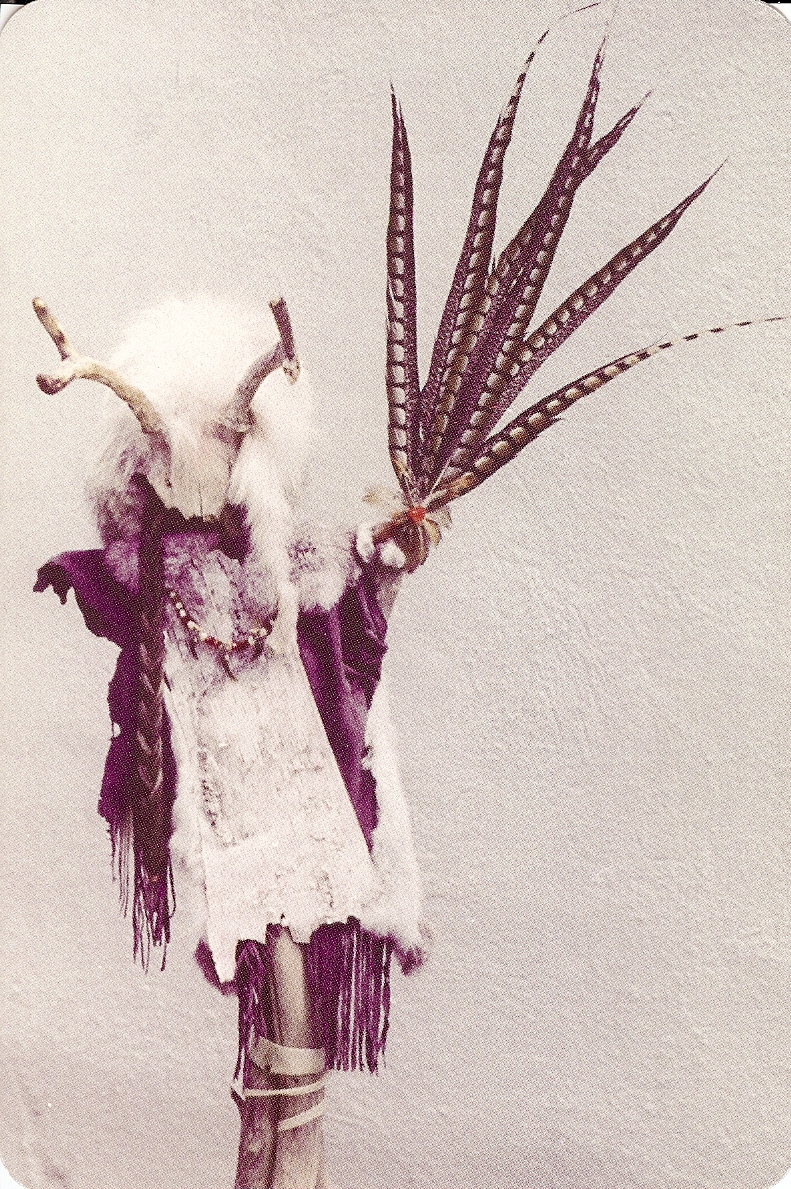 Note on the Grandmother Cards: the actual title is Grandmothers by Megan Garcia, published by Books Beyond Borders, copyright 1995; the ISBN: 1-883862-06-X. I offer all this information because the deck is out of print but is available if you search for it; I got mine in new condition from Powell Books several years ago. I’ve included here a scan of the image of Winter Birch of Woman’s Lodge so you get a sense of their style and beauty. I will scan others from time to time if their images seem important to the reading.
Something New: Goddess Guidance Oracle Cards
I missed posting yesterday; I postponed it while I was immersed in other projects. Fortunately I got a lot done, including some thinking about the direction for this blog. While I have really enjoyed posting my comments on the books I’m reading, especially my series on Joseph Gelfer’s book on Men and Spirituality, I have to streamline what this is about and also perhaps focus it a bit better.
That said I do plan to continue my reviews on what I’m reading of a spiritual nature, especially as my choices relate to men and spirituality. So, starting next week Mondays and Fridays will be given to book reviewing, and since I’m in the middle of Matthew Fox’s The Hidden Spirituality of Men I will write a series of reviews on the “Metaphors” (really archetypes) he discusses to “awaken the Sacred Masculine”. I’m sure the title alone sends a shiver up Dr. Gelfer’s spine!
On Wednesdays I will continue to comment on the The Mystic Message as channeled to Rosemary by The Divine Feminine and published each week in her Ezine and on her blog (www.wisdomconnections.net). This leaves Tuesdays and Thursdays for something new! I am going to pick up a practice I did a few years ago and share it online. For most of 2002 I drew three “oracle cards” each morning and recorded them in a journal. I wrote out a synopsis of their meanings, pulled out a theme from the three and then related them to my day. Looking back through that journal today, I recall how powerful, helpful and meaningful those cards were for me as I was living through a rather chaotic period then. I used three decks: an old Osho deck, the Voyager Tarot deck, and a deck of “Grandmother Cards”.
We have a new deck this year that Rosemary and I have both been enjoying: it is Doreen Virtue’s “Goddess Guidance Oracle Cards.” I plan to start using this deck each Tuesday and Thursday for multiple purposes:
1) the main purpose is to get a sense for the week from the oracles the Goddesses offer;
2) each card and the booklet with the deck teaches something about the Goddesses, something for all of us to learn;
3) with time we may begin to see patterns in the cards drawn which may inform how the months and year are unfolding.
I also plan to draw a Grandmother Card each day with the thought that they may amplify what the Goddesses have to offer and may also bring forward some ancient wisdom from the Native American Grandmothers represented in this deck.
OK, so I realize today is Friday, but I want to get started with this project. I also want to set an intention for this project, as noted above. So I will draw a Goddess Card and a Grandmother Card today to see what guidance they offer as we begin.
Goddess Card: Ostara – Fertility
The quote on the card is “It is the perfect time for you to start new projects, access new ideas, and give birth to new conditions.” See how this works!
Grandmother Card: Dancing Morning Star of the Wise Women
She says: “I love to dance, and the dance taught me how to be a wise woman. To dance you must discard everything but the music you feel in your body. So I released all distractions and moved in radiance to the beat of my own heart and I expanded to the stars.”
I think we are off to a good start! Ostara is the Goddess for whom the direction East, rising Sun, and Easter are named. She represents the return of light and new growth. She is a Teutonic Goddess of fertility and Spring. What better Goddess can we call upon to help with our new project! And today is Beltane Eve, the day the fires a lit on hill and mountain tops to celebrate the return of the Sun.
Dancing Morning Star says this is a time to dance, to celebrate the Sun’s return, new growth, Spring, May Day! Shall we dance the Sun up tomorrow to honor his return? Shall we turn to the East, remembering Ostara, and offer our thanks and praise for the glorious light and warmth of him who gives us life?
One of Dr. Virtue’s meanings for the Ostara Card is “Your new idea or venture will be successful.” Yes, I think She (Ostara) will help make it so!
Comments on “Numen, Old Men” – Part 4: Gay Spirituality: A Way Out for Men
As I read along in Dr. Gelfer’s book I seem to move, for me, into ever newer territory. I have had a reasonable amount of experience with the Mythopoetic Men’s Movement; I have serious grounding in Christianity and some experience with men’s ministries; I have read Wilber to a reasonable extent and am at least conversant with the Integral Model. However, while I have a number of gay friends we have never had any conversations about spirituality in the gay world. The closest I have come is an exchange with my gay Wiccan cousin [see an earlier post and his comment]. Chapter 6 of Joseph Gelfer’s book: Numen, Old Men: Contemporary Masculine Spiritualities and the Problem of Patriarchy is titled: Gay Spirituality: A Way Out for Men; and I have read it with a completely new appreciation of a previously completely unexplored area of spirituality.
While I have no way of critiquing Dr. Gelfer’s exploration in this chapter, being in this unfamiliar territory, I can certainly say it is an excellent, if “whirlwind,” survey of contemporary thought in Gay Spirituality. And he makes some excellent points along the way vis-à-vis masculine spirituality. Since this may be new territory for some of my readers I’ll attempt to summarize Dr. Gelfer’s findings and conclusions by following this chapter’s outline:
He begins by explaining that, while there is a great deal of variety in how gay men are spiritual, “gay spirituality does have some commonality beyond the fact that it is engaged by men who identify themselves as being gay: it offers the possibility for men to practice a spirituality which, for the most part, avoids the patriarchal traps which have littered the mythopoetic movement and the various Christian men’s movements.”
The first section of the chapter presents popular gay spirituality by which is meant: “the type of spirituality that resists categorization by faith tradition: it can appeal as easily to Christian mysticism as to Buddhism or Paganism. Popular gay spirituality opens a window on what is sometimes referred to as ‘gay consciousness’ or ‘gay spirit’ and it is this that provides the most obvious alternative to the patriarchal norm.” And while this is a distinct difference from what is explored in earlier chapters [about men’s movements], there are also some similarities: “popular gay spirituality draws noticeably on neo-Jungian archetypes and neo-paganism in much the same way as the mythopoetic movement.”
By way of example of popular gay spirituality, Dr. Gelfer inserts here a section on the closest thing to a gay spirituality movement: Radical Faeries. “The typical Faerie is ‘firmly committed to counterhegemonic values’ and in particular seeks to subvert a normative understanding of masculinity.” They do, however, rely on archetypes, especially the Androgyne, and in this there is a lot of similarity to the mythopoetic movement. “The most prevalent of Faerie spiritual beliefs draw upon Wicca and neo-paganism, most notably of the Goddess/Earth Mother.” This points to a clear connection to Robert Bly who established the Conference of the Great Mother in 1975! And what I would conclude here it that my blog is aptly titled and a clear pointer to “a way out for men.”
The next section presents gay theology. “Gay theology is underpinned by a critical awareness of how patriarchy operates within society and spirituality to shut down atypical masculinities in a way that is almost wholly absent in either the mythopoetic or Christian men’s movements.” This political awareness is central to gay theology. Four types of gay theology are explored in this section: gay liberal theology, gay liberation theology, erotic/lesbian theology and queer theology. And it is this last type which may contain the most hope for all of us: “queer theology, instead of asking gay and lesbians to come out, … seeks to liberate all people from constructions of sexuality and gender.”
And Dr. Gelfer explores this last type of gay theology in his final section: A Spiritual Queer-For-All. “To queer something is to disrupt and problematize the norm, particularly (although not exclusively) in terms of gender, thus ‘queer theologies are a refusal to normalization…'” He makes the point here that queering something is to move it way from the norm, thus liberating it from the expectations of heteronormativity. “As we move into queer realms, those aspects[e.g. resistance to patriarchal spiritualities] become less identifiably ‘gay’ and therefore are even easier to apply to straight men or, more specifically any man, as queer also troubles a “straight’ identity. A good deal of this section discusses the application of queer theory for straight men, which at first glance may appear like the co-option of the queer in a continued campaign of heteronormativity, and a glossing over of the spiritual experiences of queer people. However, the aim is not to focus on straight men per se but simply to offer them as the missing variable in the equation of queer potential for all men.” Dr. Gelfer concludes this section by claiming: “Queer theology is the way out for any person who wants to articulate a non-patriarchal masculine spirituality.”
Even so, Dr. Gelfer concludes this chapter by saying: “We still have no useful (non-heteropatriarchal) application of the phrase ‘masculine spirituality’.” He explores this further in Chapter 7: Sexual Difference, Spirituality and Space, which I’ll review tomorrow.
I have used a lot of Dr. Gelfer’s own words in this post today; this is because I am in unfamiliar territory. But he has given me much food for thought and an excellent bibliography on the subject of Gay Spirituality. Clearly, there are gems of wisdom and an evolutionary path to be explored here.
Am I ready to “queer my approach” to Men and the Goddess? Or, by definition, have I already done so!
Queen of Heaven
We are in store for a beautiful weekend in Colorado. I hope you have a wonderful one wherever you are! On Sundays Rosemary and I host “Sundays at The Center“, a celebration of spirit. During our celebration this Sunday I plan to talk about Isis and some of what I’ve been reading which connects her to alchemy. It is also clear to me that she is connected to Inanna, Sumerian “Queen of Heaven” of whom I’ve written earlier in this blog.
 The origin of the Egyptian Goddess, Isis, is unknown. But at some point in her history and associated stories it becomes clear that there is some linkage to the Sumerian Inanna and the Semitic Ishtar. First, along with Mari, Diana, Hecate, Pasiphae, Selene, Brigit, Cybele, the Shekinah, Lilith, and Persephone, they are Moon Goddesses (ref: Diane Wolkstein in Inanna, Queen of Heaven and Earth). And the three were also known as “Queen of Heaven.” How much cross-cultural exchange took place across the middle east from the Mediterranean area to Mesopotamia is unknown. But the parallels of myths, stories and religious rites and observances is highly synchronistic.
What are we dealing with here historically? Was there significant exchange across these civilizations or are we seeing an archetype at play? And does this archetype continue to play out in our lives today? One of the dominant religions of today, Christianity, has at its core a story which resembles the Isis/Osiris/Horus story with uncanny parallels. Yes, until recently, the patriarchy has driven much of the Isis story out of Christianity. But Mother Mary and Mary Magdalene are coming back into their own. Is this archetypal or cultural mixing of stories?
I did not realize before my deeper readings into the stories of Isis that her significance and recognition as the Queen of Heaven extended throughout the Mediterranean area, even reaching Britain, and lasted well into the first millennium AD! The last temple of Isis and Osiris continued in operation on the island of Philae in the Upper Nile into the 6th century. How much influence did the parallel worship of Isis have on the Christian mythos? We know that Christian churches and holy sites are built over more ancient spiritually significant sites throughout the world. The Church adopted calendars, saints and sites to fit as an overlay and displace what came before. How much of the story of Jesus, the whole basis of a dominant world religion, is nothing more than an overlay on stories which came before?
What did change in translating the stories of Inanna and Isis to Christianity was the loss of the Feminine as the Masculine worked to dominate and control. The various cults of Isis rose in the Egyptian Delta area; they varied from city to city; they rose in power above the cults of Ra, the masculine; but I find no evidence of a purge of all worship of Ra in order for the Feminine Isis to dominate. This displacement was a gradual shift from masculine to feminine influence. The Christian story is different: The Theodosian decree (in about 380 AD) required the destruction of all pagan temples. Control. The masculine approach to imposing rules on the population.
Marie-Louise von Franz describes the masculine this way: “With this development and increase in the sun cult came a development in law, science, geometry, the planning of fields, of buildings, and so on. There was an enormous progress in rational civilization and in organization and war, etc. That was a development of the masculine world, of the mind world and the world of order”. Sound familiar? It was after this “increase in the sun cult” (by a couple thousand years) that the “men became tired” and the cult of Isis rose – enantiodromia.
We are due for another episode of enantiodromia. We are watching the failing and fading of the current age of masculine dominance. We are in the middle of a swing away from rationalism and war. At least I hope we are! It is time for us to pay attention to the Queen of Heaven. She is due!
Enantiodromia; are we in it? We can hope so!
It was a lovely day in Colorado after our snow on Tuesday which was enough to cancel one of our scheduled meetings. The snow is all gone, soaking into my grass to green it. Perhaps we can say in Colorado at this time of year we are in a period of enantiodromia: the warm spring 60 and 70 degree temperatures bring about the spring snow, and then we bounce back to the warm spring…
Wikipedia says this: “enantiodromia is a principle introduced by psychiatrist Carl Jung that the superabundance of any force inevitably produces its opposite. It is equivalent to the principle of equilibrium in the natural world, in that any extreme is opposed by the system in order to restore balance.” I encountered this word in my current book on alchemy by Marie-Louise von Franz which I’ve mentioned before in these posts. And what in particular caught my attention was her reference to the rise of Isis in Egypt as a central Goddess, even the most powerful of all the gods/goddesses.
She first tells the story of the rise of the cult of the sun god, Ra, around 3,000 to 2,800 BC; sun worship gradually exceeded that of the moon and bull worship (end of the Age of Taurus), an enantiodromia. This gave rise to a patriarchal social and political order. As Ra became old and senile, Isis, using a poisonous serpent or worm and then healing him, tricked him into giving her his secret name, and thereby all his power. “…at the end of the Egyptian civilization there was a similar enantiodromia. Suddenly Isis got everything into her hands and the male gods faded – and it is interesting that that was at the end of the Aries age and that now we are at the end of the Pisces, the astrological fish age, and again a woman is gathering the harvest and the men are a bit tired.” Wow! Von Franz said this in 1959!
Is the patriarchal political and social order under which we have lived our whole lives truly at an end? Are the men “a bit tired”? And where is our Isis, our Inanna, when we need them?
The Isis story is certainly a parallel with the Inanna story to which I’ve referred before. Her descent into the underworld gave her king and husband, Dumuzi, just the opportunity he needed to take charge; and of course he did! This was an enantiodromia. But Inanna was able to come back from the underworld to rule again; poor Dumuzi had to spend half of each year in the underworld in exchange for Inanna’s rise. (And his poor sister spent the other half of the year “down there” representing a nice balance).
Do these myths and archetypal examples of enantiodromia condemn us to forever shift from one extreme to another as we struggle as a humanity for power and control? I say in my title “we can hope so” that we are in a period of enantiodromia; that we are experiencing tired men and the rise of the Goddess, the power of The Feminine. I say this not because I think a feminist, goddess dominated matriarchal society would be better but because I have lived with what the patriarchal, masculine, “god the father” dominated society has generated. I am looking for balance; and maybe, just maybe as we swing back from the extreme through this enantiodromia principle, we can somehow arrest the pendulum’s swing more toward the center.
Can the “new human” figure out a way to share power and control without regard to gender? Is there a balance between masculine and feminine principles we can apply to our social and political struggles so they become less struggle and more cooperation?
As we move toward a new astrological age, the Age of Aquarius, let’s hope we are in a new period of enantiodromia but that the opposites move to balance!


 Men and The Goddess